
So wonderful again to be able to share our great sport with the
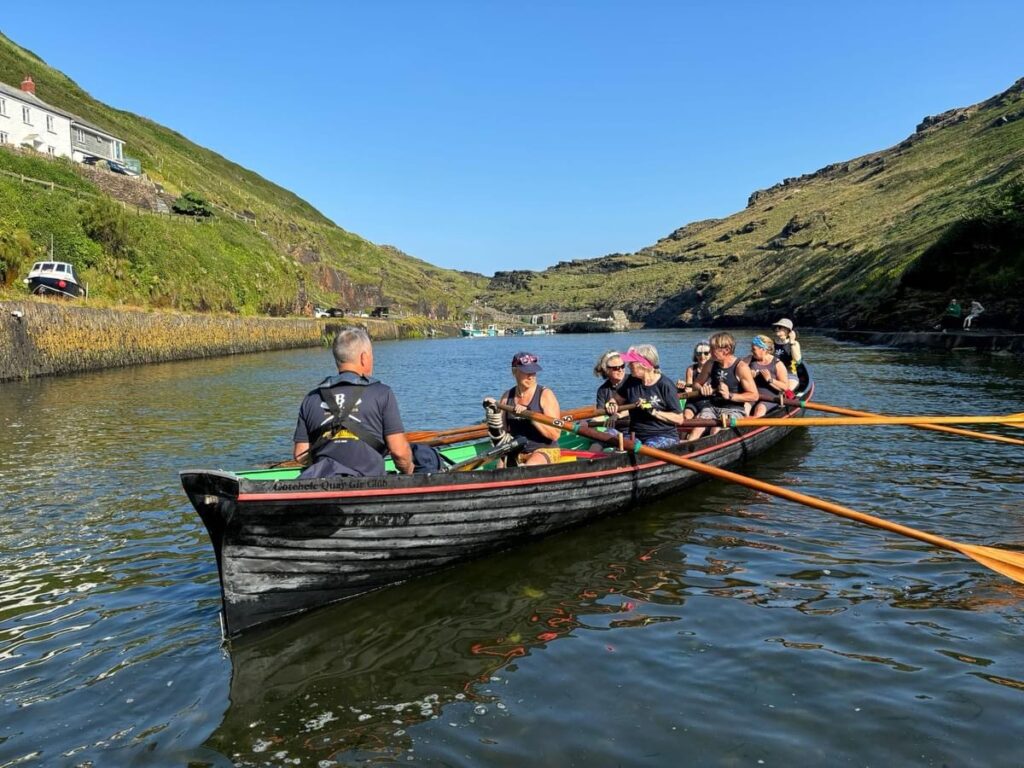
community now the new ‘Boscastle Sound’ is up and running. You may have
seen these intriguing crews and boats rowing out of the harbour
occasionally and watch us disappear into the Atlantic mist!
[pmb_web_only_blocks]

[/pmb_web_only_blocks]
Boscastle and Crackington Haven gig club (BCGC) was formed in 2005
following some Govt grant funding post the 2004 flood. We row from
Boscastle Harbour and Roadford lake. We compete and train at regattas
or venues all around the South West including the prestigious World
Championships at the Isles of Scilly.
Cornish pilot gig rowing is a traditional sport with deep roots in
Cornwall. The history dates back to the late 18th century and is
intertwined with the coastal communities’ need for speed and skill on
the water.
Early origins:
• 18th Century Beginnings: Cornish pilot gigs were originally used for
the practical purpose of transporting pilots to incoming ships. Pilots
were essential for safely guiding vessels through the treacherous
coastal waters of Cornwall.
• Rivalry was fierce among pilots to be the first to reach incoming
ships as the first boat to arrive would secure the lucrative job of
guiding the vessel. This necessity for speed and efficiency drove the
design and construction of the gigs.
• Traditional Build: Cornish pilot gigs are traditionally wooden rowing
boats measuring around 32 feet long with a beam of 4 feet 10 inches.
They are built from narrow-leaved elm (though other woods are sometimes
used) and are clinker-built (overlapping planks).
• Seymour’s “Treffry”: The oldest known surviving gig, “Treffry,” was
built in 1838 by boatbuilder William Peters of St Mawes and set a
standard for the design of future gigs.
• 19th to 20th Century: As the demand for piloting declined with
technological advancements in shipping, gig rowing transitioned from a
necessity to a competitive sport. Communities along the Cornish coast
began to race these boats for recreation and local pride.
• By the mid-20th century, organised racing began to take shape. Clubs
were formed, and regular competitions were held.
• Today, there are numerous gig clubs across Cornwall, the Isles of
Scilly and beyond, including some international locations. These clubs
maintain and race traditional wooden gigs and some now use modern
fibreglass replicas for training.
In summary, Cornish pilot gig rowing has evolved from a practical
maritime activity into a celebrated and competitive sport, maintaining
strong cultural and historical ties to Cornwall’s coastal communities.
We have about 80 members of all ages from 18 to 80 also an up and coming
junior section. The benefits of gig rowing are enormous whether you want
to social row, compete, be part of a social group or just use it as a
nice way to improve physical and mental well being. We are always
looking for new members and juniors so if you are interested and fancy
a go on a taster day just drop us a line at Boscastlegigclub@gmail.com
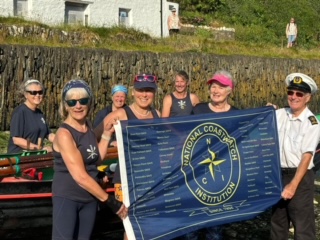
As a club we get involved in so many events around the UK and by example
we recently celebrated one of our essential partners, The National Coast
Watch Institutes, 30 year anniversary by helping them move their flag
down the North coast using one of our gigs. It was an amazing day topped
off nicely by a visit from a pod of dolphins!
Looking forward to regular updates for you all and if you see us down by
the slipway please come and say hello.
Paul Cook, Chair BCGC